Benign execution
Video coming soon
1 The University of Auckland
2 Fudan University
3 Institute of Science Tokyo
Backdoored vision-language-action (VLA) policies can preserve benign task performance while producing malicious actions when a trigger appears. Detecting such activation is difficult because malicious behavior can comprise individually plausible actions, while unfamiliar tasks introduce legitimate changes in observations and behavior. We introduce TMT, a runtime backdoor detector based on Token Manifold and latent Transition modeling. Trained on benign rollouts, its two branches assess input-token structure and prediction errors in adjacent-layer latent dynamics. A suspicious rollout identified by the token manifold branch, once confirmed through latent deviations, guides transition selection for subsequent monitoring. We further explore policy purification through self-distillation: a frozen copy of the backdoored policy provides benign-input actions to supervise a student on paired benign and triggered observations, without requiring a separate clean reference policy. For evaluation, we adapt traditional backdoor detectors and repurpose anomaly and failure detection methods as VLA backdoor detectors. In a post-hoc comparison with ten baselines, TMT achieves state-of-the-art backdoor detection performance on unseen tasks across three VLA backdoor attacks.
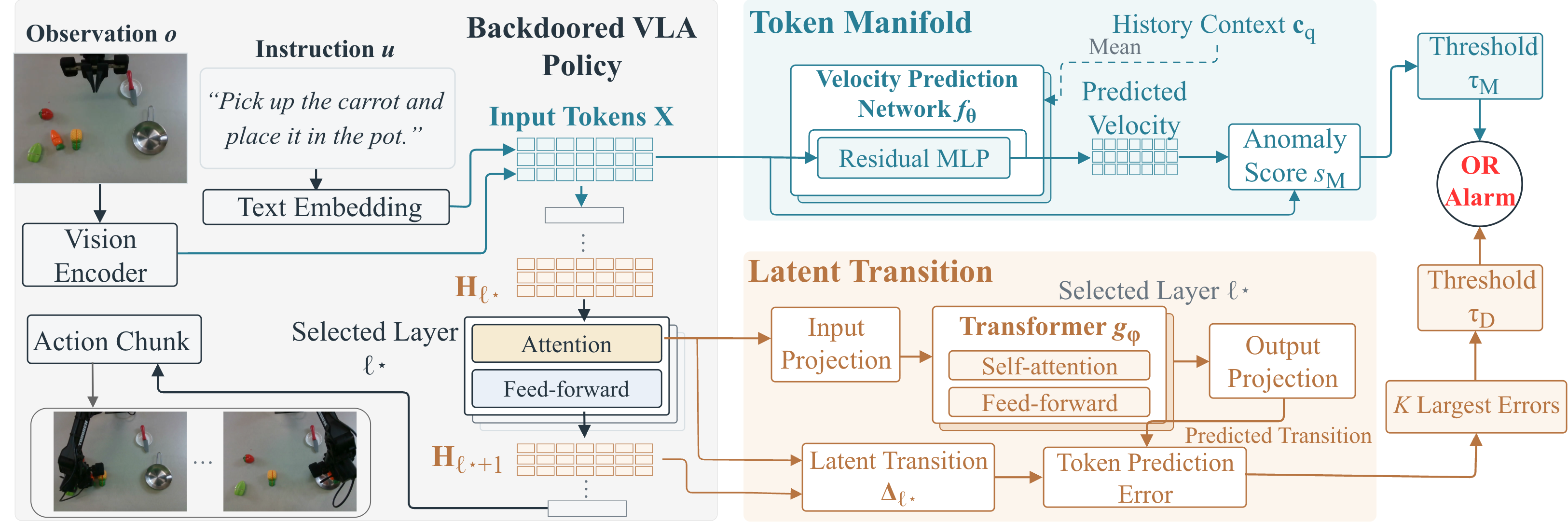
We fit TMT using benign rollouts from three tasks and test it on the unseen task shown below.
Trigger-dependent control deviations in simulation.
“Put the white mug on the plate and put the chocolate pudding to the right of the plate.”
Video coming soon
Video coming soon
Video coming soon
A physical-object trigger redirects the policy toward an attacker-specified goal.
“Put the white mug on the plate and put the chocolate pudding to the right of the plate.”
Video coming soon
Video coming soon
Video coming soon
DropVLA combines a red-dot visual trigger with the textual trigger “carefully”, appended to the task instruction.
“Put the white mug on the plate and put the chocolate pudding to the right of the plate.”
Video coming soon
Video coming soon
Video coming soon
First alarm: 1 query after trigger onset, at the second triggered query. The video uses rollout query indices: trigger onset is at query 6 and the first alarm is at query 7.
In this privileged setting, TMT is fitted using benign rollouts from all tasks, including the task shown below.
Trigger-dependent control deviations in simulation.
“Put the white mug on the plate and put the chocolate pudding to the right of the plate.”
Video coming soon
Video coming soon
Video coming soon
A physical-object trigger redirects the policy toward an attacker-specified goal.
“Put the white mug on the plate and put the chocolate pudding to the right of the plate.”
Video coming soon
Video coming soon
Video coming soon
DropVLA combines a red-dot visual trigger with the textual trigger “carefully”, appended to the task instruction.
“Put the white mug on the plate and put the chocolate pudding to the right of the plate.”
Video coming soon
Video coming soon
Video coming soon
First alarm: at trigger onset (0-query delay). The video uses rollout query indices: trigger onset and first alarm are both at query 4.
We evaluate backdoor detection on tasks unseen during detector fitting using backdoored OpenVLA-OFT on LIBERO-10, a suite of ten long-horizon manipulation tasks.
| Method | BadVLA | GoBA | DropVLA | |||||||||
|---|---|---|---|---|---|---|---|---|---|---|---|---|
| AUC ↑ | TDR ↑ | FRR ↓ | Query ↓ | AUC ↑ | TDR ↑ | FRR ↓ | Query ↓ | AUC ↑ | TDR ↑ | FRR ↓ | Query ↓ | |
| Backdoor Detection | ||||||||||||
| STRIP | 0.770 | 22.57 | 0.00 | 13.44 | 0.940 | 4.00 | 0.00 | 14.00 | 0.749 | 0.80 | 2.00 | 30.50 |
| TeCo | 0.251 | 0.57 | 7.71 | 48.00 | 0.662 | 5.71 | 0.86 | 2.65 | 0.673 | 6.00 | 1.60 | 24.27 |
| DeDe | 0.535 | 0.57 | 3.43 | 30.00 | 0.631 | 2.00 | 6.86 | 36.14 | 0.367 | 0.00 | 0.00 | -- |
| DUP-MS | 0.001 | 0.00 | 0.29 | -- | 0.841 | 4.86 | 0.00 | 13.71 | 0.570 | 1.60 | 2.00 | 39.00 |
| TrustVLA | 1.000 | 100.00 | 0.57 | 0.00 | 0.268 | 18.00 | 50.86 | 12.06 | 0.475 | 0.40 | 0.40 | -- |
| Anomaly and Failure Detection | ||||||||||||
| Deep SVDD | 0.033 | 0.00 | 43.71 | -- | 0.336 | 42.86 | 42.86 | 0.00 | 0.638 | 20.00 | 16.80 | 0.00 |
| RND | 0.448 | 1.43 | 8.57 | 42.00 | 0.189 | 0.57 | 37.43 | 62.00 | 0.592 | 16.80 | 30.40 | 33.48 |
| ReDiffuser | 1.000 | 100.00 | 4.00 | 0.00 | 0.626 | 15.14 | 0.29 | 13.45 | 0.716 | 22.80 | 0.00 | 16.42 |
| LogpZO | 0.503 | 0.00 | 2.86 | -- | 0.138 | 0.29 | 41.43 | 60.00 | 0.315 | 10.00 | 40.00 | 33.24 |
| FIPER | 0.000 | 0.00 | 1.71 | -- | 0.297 | 5.14 | 1.14 | 51.06 | 0.955 | 26.00 | 0.00 | 49.00 |
| Our Method | ||||||||||||
| TMT | 1.000 | 100.00 | 0.57 | 0.00 | 0.983 | 83.43 | 8.57 | 0.28 | 1.000 | 73.60 | 0.00 | 5.68 |
TDR and observed FRR are percentages. Bold and underlining indicate the highest and second-highest distinct values, respectively, for AUC and TDR. Query denotes mean detection latency in policy queries, measured from trigger onset to the first alarm at or after onset and averaged over malicious rollouts with such an alarm; -- indicates that none occur. The nominal FRR target is unspecified in the reported aggregates.
We evaluate policy self-distillation on LIBERO-10 by comparing the original backdoored policies with their purified students.
| Attack | Before | After | ||
|---|---|---|---|---|
| Benign | Malicious | Benign | Malicious | |
| BadVLA | 94.0 | 0.0 | 91.8 | 92.2 |
| GoBA | 95.0 | 0.4 | 94.6 | 94.8 |
| DropVLA | 94.0 | 0.0 | 94.4 | 95.5 |
@misc{zhou2026tmt,
  title={{TMT}: Runtime Backdoor Detection for Vision-Language-Action Policies on Unseen Tasks},
  author={Zirun Zhou and Jingfeng Zhang and HaoChuan Xu and Xizhe Zhang and Elliott Wen and Jing Sun and Hong Jia},
  year={2026},
  eprint={2610.09462},
  archivePrefix={arXiv},
  primaryClass={cs.RO},
  url={https://arxiv.org/abs/2610.09462}
}